




Searching for a roller coaster for sale is the beginning of a substantial park-planning decision. A coaster is a track-based passenger attraction, but its commercial value depends on much more than height or top speed. The right project has to fit the intended riders, available land, practical queue capacity, maintenance resources, and the park’s long-term development plan.
MODERN manufactures coaster models ranging from compact layouts to larger systems for high-traffic venues. Its roller coaster product range includes family, mini, and spinning configurations. Coasters may be the main draw in a park, but they should also be considered alongside other thrill ride types so that the overall attraction mix serves the intended audience. This buyer’s guide compares coaster categories, presents named-model specifications, and explains how to obtain a useful project quotation.
Main Types of Roller Coasters for Sale
الأفعوانيات العائلية
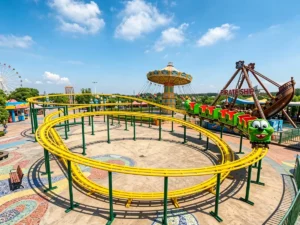
Family coasters are intended to provide track movement and a recognizable coaster experience for a wider visitor segment, subject to model-specific rider restrictions. Their role can be especially important in a family park or scenic destination where not every guest wants an intense attraction. Rather than selecting solely by height, ask how the proposed layout supports the rider profile and complements the park’s other experiences.
When reviewing family roller coaster options, compare passenger capacity, station and queue requirements, route geometry, visibility from surrounding paths, and access for inspections. A family coaster can still require significant foundations and service space, so it should not automatically be treated as a small-footprint purchase.
Mini and Junior Roller Coasters
Mini or junior coasters are considered when the intended riders and project scale call for a more compact track attraction. They may suit a children’s or family zone where the goal is to introduce a coaster-style experience without making extreme motion the central feature. As with any ride for younger visitors, the supplier’s published admission rules, restraint design, and supervision requirements must determine actual suitability.
Review the mini roller coaster range against the usable site envelope, not only the outer track boundary. Station access, pedestrian routes, emergency access, and any operational buffer zones can occupy space that is not obvious in a product photograph.
Spinning Roller Coasters
Spinning coasters add vehicle or car rotation to the travel along the track. That extra motion changes the rider experience and introduces another element for the buyer to evaluate in operation and maintenance. The importance of rotation depends on the design: a stated rotational rate cannot be compared directly with a train’s forward speed in kilometers per hour.
تشكيلة spinning coaster models can be considered for venues seeking a different ride sensation within a defined track layout. Ask for the manufacturer’s explanation of rotating components, loading and passenger-balance rules, maintenance access, and approved operating limits. The decision should rest on a full technical specification rather than the general term “spinning.”
Larger Multi-Element Track Layouts
Larger roller coasters may incorporate multiple vertical and horizontal track elements, more extensive structures, and a more prominent park profile. They can serve as destination attractions where the target market and land allocation justify the investment. Their scope should be judged by track geometry, supported operating cycle, passenger train configuration, and the ability to maintain the installation over time.
Height and speed are useful engineering data, but neither proves that one model is the best commercial choice. The layout must be integrated with access roads, building zones, queue lines, utility routes, and the park’s future expansion. A detailed drawing is more valuable for this decision than a headline performance number alone.
Representative Roller Coaster Specifications
The following examples come from MODERN’s published model listings. They illustrate differences in track length, height, power, and occupied area; they are not industry-wide standards and should not be used as guaranteed specifications for custom layouts. “Not stated” means the particular value was not provided in the verified model details used for this guide.
| طراز MODERN | Track length | Height | Published movement figure | السعة | الطاقة | Floor area |
|---|---|---|---|---|---|---|
| Five Ring MRC02S | 475 m | 22 m maximum track height | 65 km/h maximum speed | 16 riders | 75 kW | 90 x 40 m |
| Middle Three Ring GSC03M | 440 m | 22.6 m track height | 61.24 km/h maximum speed | 16 riders | 55 kW | 85 x 36 m |
| Family GSC02 | Not stated | 11 m equipment height | Not stated | 16 seats | 96 kW | 30 x 47 m |
| Crazy Mouse SZCL04 | 180 m | 6 m track height | Up to 35 km/h | 4 cars; rider total not stated | 10 kW total | 17 x 28 m |
| Spinning RC5-20L | 320 m | 11 m | Up to 2 rps published rotation figure | 20 riders, 5 cars | 40 kW | 34 x 23 m |
The Five Ring MRC02S is listed with a 110-second circuit and a track arrangement containing two vertical rings, two spiral elements, and one horizontal ring. The Middle Three Ring GSC03M has a published 90-second running time per round. Such figures help the planning conversation, but an operating cycle is not identical to the full time needed for dispatch, loading, unloading, and checks. The actual possible guest throughput must be assessed with the proposed station and operating plan.
The Spinning RC5-20L specification lists a figure of up to 2 revolutions per second; because this is a rotational unit, it should not be compared directly with the linear speed figures in the other rows. Verify the exact meaning and applicable conditions of every listed movement figure in the technical offer. Likewise, the different labels used for equipment height and track height should be clarified before making engineering comparisons.
What Does a New Roller Coaster Cost?
A realistic roller coaster price depends on the engineered project. MODERN does not publish fixed prices online, and this guide does not assign unverified currency ranges to its models. Even two coasters with similar passenger capacities can require very different materials, civil works, foundations, and site services. The useful question is what is included in the total proposal for a particular site.
- Track length and layout complexity: Geometry, supported elements, structural supports, and manufacturing scope affect the amount and nature of equipment required.
- Height and ground conditions: Taller or more complex structures must be engineered for the destination site, with foundation requirements determined by the actual design and ground investigation.
- Trains, cars, and station: Passenger capacity, vehicle configuration, dispatch arrangements, loading platforms, and access provisions influence the delivered system.
- Theming and surrounding works: Decorative treatment, station buildings, paths, fencing, landscaping, and queue structures may be separate line items.
- Electrical and control infrastructure: Power supply, distribution, control systems, and interfaces with the venue need to be identified and coordinated.
- Transport and implementation: Packaging, freight, lifting, installation, commissioning, testing, training, and after-sales support should be clearly scoped.
A quotation that appears less expensive may simply exclude foundations, local works, or installation responsibilities. Compare offers on an equivalent basis: model specification, drawings, technical documents, services, exclusions, and project milestones. Ask which items are fixed and which depend on later site verification. This produces a more useful comparison than treating a generic “roller coaster for sale” listing as a final installed price.
How to Buy a Roller Coaster: A Step-by-Step Path
Step 1: Define Your Guest Market and Operating Goal
Describe the audience you want the coaster to serve, including likely age groups and the role of the ride in the park. Is it primarily a family attraction, an introduction to coasters, an interactive spinning experience, or a landmark thrill ride? Set an expected visitor-flow objective, but distinguish it from a manufacturer-confirmed operating capacity.
Step 2: Document Site Constraints
Prepare a dimensioned site plan showing boundaries, ground levels, access roads, existing structures, overhead obstacles, utilities, and any known restrictions. Include the available electrical service and the surrounding circulation plan. If soil or foundation information is not yet available, identify that gap instead of assuming it will not affect equipment selection.
Step 3: Shortlist Coaster Types and Request Layouts
Select a manageable group of options from the family, mini, spinning, or larger track categories. Ask for a proposed layout indicating the ride footprint, complete operational envelope, station, queues, emergency access, and maintenance space. A properly engineered proposal should explain how the equipment will fit the actual site rather than rely on nominal dimensions from another project.
Step 4: Compare Documented Technical Offers
Request the proposed model, train or car configuration, rider limits, track data, power requirements, operating assumptions, available documentation, and the complete commercial scope. Review the manufacturer’s quality-management and production credentials. MODERN reports CE and ISO 9001 certifications, Chinese special-equipment manufacturing and installation licenses, and project deliveries to more than 100 countries. Buyers can examine MODERN’s company qualifications and services while verifying documents relevant to the exact coaster and destination market.
Step 5: Plan Civil Works and Logistics
Coordinate the foundation design, site preparation, electrical supply, installation access, and delivery route before committing to the construction schedule. Clarify who is responsible for local contractors, cranes, permits, inspections, customs-related documentation, and site readiness. A site that is not prepared for delivery can create delays even when manufacturing is complete.
Step 6: Confirm Commissioning, Training, and Handover
Identify the planned sequence for delivery, assembly, commissioning, required checks, authority acceptance, and staff training. Agree on maintenance documents, spare-parts planning, and after-sales support. The owner’s long-term capability to operate and maintain the ride is an essential part of selecting a coaster, not an issue to postpone until opening day.
Safety Standards and Supplier Due Diligence
Amusement ride safety should be assessed using relevant design documents, applicable standards, local requirements, and the actual equipment configuration. ASTM F2291 establishes design criteria for amusement rides and major modifications. The U.S. Consumer Product Safety Commission also lists voluntary ASTM consensus standards concerning ownership, operation, maintenance, inspection, quality of manufacture and construction, and measurement of dynamic characteristics. These references are voluntary consensus standards, not a statement that every jurisdiction follows identical legal rules.
The European EN 13814:2019 series covers fairground and amusement park machinery and structures, including roller coasters. It addresses design safety and subjects related to operation, maintenance, control, and testing. A buyer should ask which standards and conformity requirements apply in the destination market and obtain model-specific documentation. CE marking and ISO 9001 credentials are useful subjects for due diligence, but neither replaces engineering review, commissioning, inspections, or competent daily operation.
Choose a Coaster Around the Whole Project
The best purchasing shortlist is defined by guest suitability, land efficiency, credible capacity planning, technical support, and the true installed scope. Use published model data to compare possibilities, then obtain project-specific drawings and documentation before treating any option as final. Maximum speed alone is not a meaningful substitute for long-term operational fit.
To discuss a new roller coaster, contact MODERN for an engineered project proposal. Share your site dimensions, target audience, intended coaster type, and budget range so the manufacturer can discuss configuration, civil-work assumptions, and delivery requirements in one coordinated quotation.