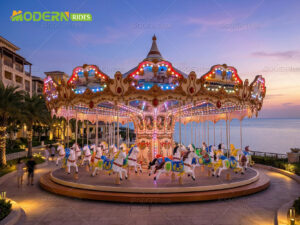






1. Why is Carousel Ride often the last ride operators consider—but the first to stabilize revenue?
A Carousel Ride is rarely the most exciting attraction, so it’s often placed later in the investment plan. However, once the park begins operating, it quickly becomes one of the most consistent revenue sources.
The reason is simple: it serves a wider audience and runs almost continuously throughout the day. While high-thrill rides depend on peak demand, a Carousel Ride fills the gaps between those peaks, ensuring steady passenger flow and reducing idle time across the park.
2. What actually determines the right Carousel Ride size for a project?
Choosing the right Carousel Ride is not just about budget—it’s about matching capacity with real visitor flow.
Smaller models are suitable for limited spaces or low-traffic areas, while larger double-deck versions are typically used where:
- visitor volume is consistently high
- the ride also serves as a visual focal point
- queue demand can be maintained
Oversizing a Carousel Ride often leads to underutilization, which directly affects return on investment.
3. Is a luxury Carousel Ride really worth the extra investment?
A high-end Carousel Ride does more than provide rides—it enhances the overall perception of the park.
In commercial areas or tourism-focused projects, a visually strong carousel can:
- attract foot traffic from a distance
- increase photo-sharing and exposure
- improve the perceived value of the park
However, in smaller local parks, the return from visual upgrades may not justify the added cost. The decision should depend on whether the project relies on visual attraction or operational efficiency.
4. How does Carousel Ride contribute to overall park traffic flow?
A Carousel Ride plays a structural role in park layout rather than acting as a standalone attraction.
Because it has:
- short cycle times
- continuous boarding
- broad audience appeal
it helps maintain movement within the park, preventing congestion in high-demand areas and reducing downtime between major attractions.
In many successful parks, the Carousel Ride is placed strategically to connect different zones and smooth out visitor distribution.
5. What are the most common mistakes when investing in a Carousel Ride?
The most frequent issue is underestimating its operational role.
Common mistakes include:
- treating it as a decorative ride instead of a revenue unit
- placing it in low-traffic areas
- choosing size based only on budget rather than capacity planning
A well-positioned and properly sized Carousel Ride often performs far better than expected, while a poorly planned one may remain underused despite good design.