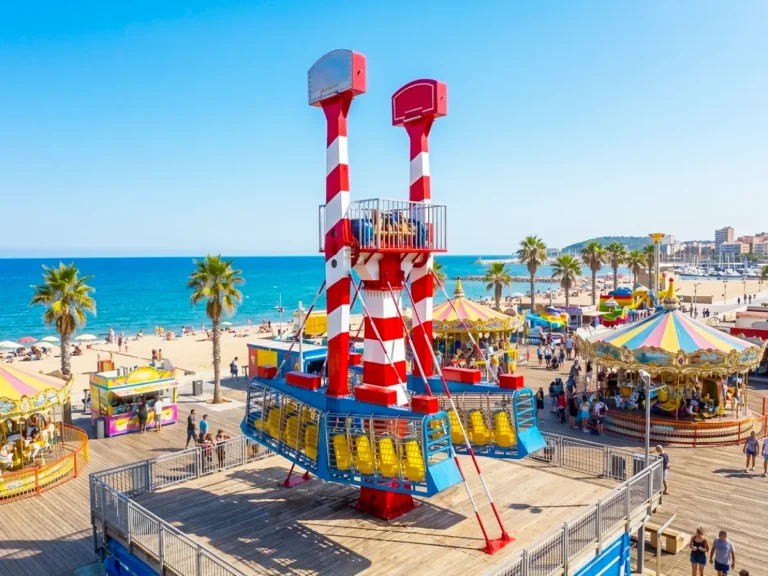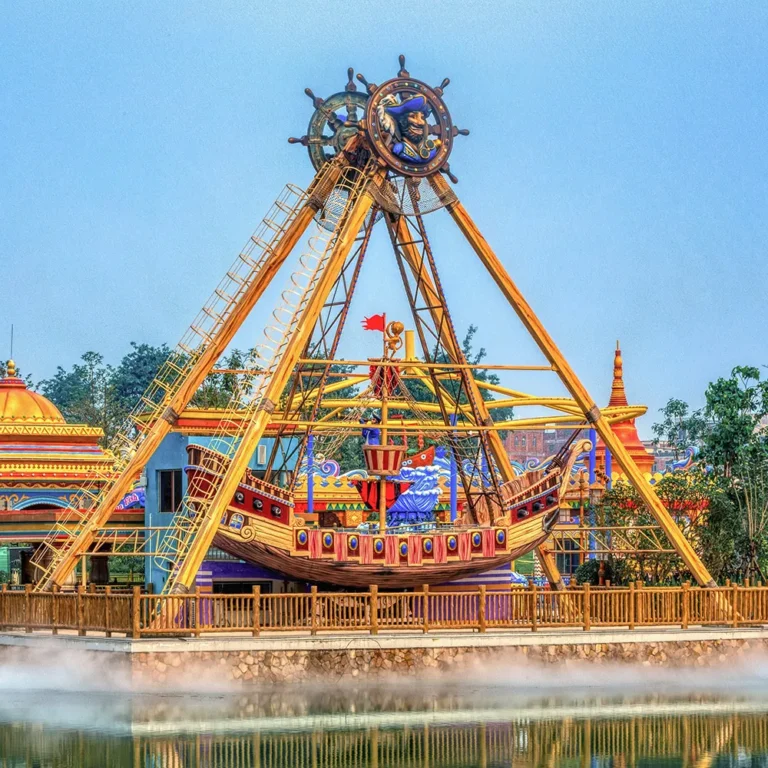




A swinging ship ride, also called a pirate ship ride, is a recognizable amusement park attraction in which a suspended boat moves repeatedly through an arc. Its combination of visible movement, rising anticipation, and straightforward ride concept makes it relevant to family-oriented parks as well as venues seeking a stronger mid-thrill experience. For buyers, however, a pirate ship is not a single standard-size product.
Available versions vary in the number of passengers, movement envelope, equipment height, foundation requirements, appearance, and installation approach. A compact mini ship may fit an intimate children’s or family area, while a larger vessel requires a different approach to site planning and visitor management. This guide explains how the ride works, compares published model examples, and outlines what affects the price of a project-specific purchase. MODERN’s pirate ship ride selection includes multiple seat counts and mobile configurations.
How Does a Swinging Ship Ride Work?
The basic motion is pendulum-like. A passenger boat is suspended from a supporting structure and driven through alternating forward and backward swings. As the boat rises toward the ends of its travel, its motion slows and changes direction. During the descent, the vehicle gains speed; the next upswing gradually reduces that speed again. The changing movement and view create the characteristic sensation associated with the swinging ship.
Two specifications deserve special attention: swing angle and operating envelope. The swing angle describes the travel of the moving assembly relative to a reference position, while the envelope describes the space occupied as it moves. Models with different heights, hull proportions, and approved angles can produce different experiences even when they have similar passenger counts. Request the manufacturer’s drawings and angle definitions instead of comparing isolated numbers without context.
Riders may also experience the movement differently depending on their seat position. The visible rise of the boat’s ends and the changing sightline can alter the perceived intensity across the seating layout. Actual motion and loading conditions are specific to the design; operators should use the approved seating, balance, restraint, and loading instructions for each model rather than promising a particular sensation in a given row.
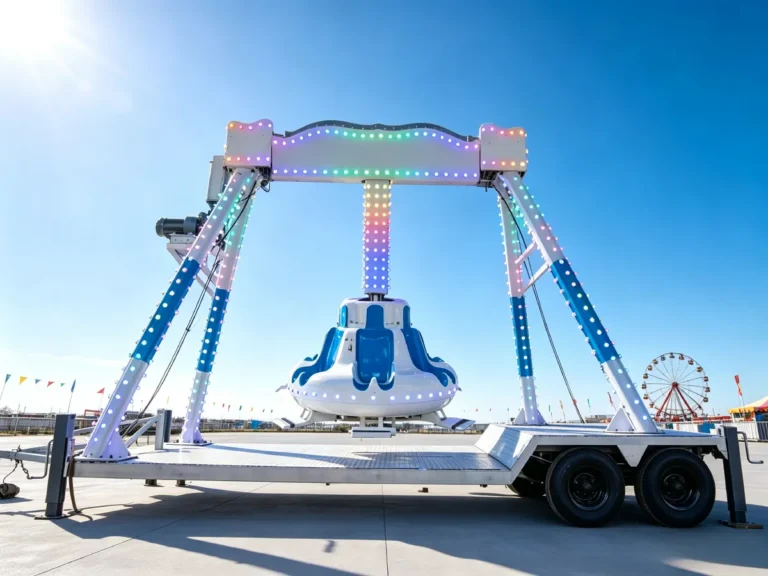
A swinging ship is related in concept to other oscillating attractions, but it should not be treated as identical to a larger rotating pendulum machine. MODERN also offers dedicated pendulum rides, which can be evaluated separately when choosing the intensity and variety of a park’s thrill-ride mix.
Typical Swinging Ship Sizes and Seat Configurations
MODERN lists mini and small swinging ships along with larger configurations, including 12, 24, 36, and 42-seat offerings. The manufacturer also publishes technical data for particular 32- and 40-seat models. The following table presents those specific published examples. It should not be interpreted as a universal dimensional standard for all pirate ship rides, nor should different definitions of area be treated as interchangeable.
| Published MODERN example | Passenger capacity | Equipment height | Published area information | Selected motion / power data |
|---|---|---|---|---|
| Mini pirate ship | 10 riders | 3.3 m body height | 5.7 x 2.6 m area | +/-50 degree angle; 4 kW |
| Small pirate ship | 10-12 riders | 3.65 m | 3.1 x 4.6 m floor area; 4.5 x 6.5 m safe distance | 30 degree angle; 4 kW |
| 24-seat model | 24 riders | 7.5 m | 12 x 8 m stated area | 11 kW; 380 V |
| 24-seat Ocean model | 24 riders | 8.5 m | 13 x 8 m stated area | 11 kW; 380 V |
| 32-seat model | 32 riders | 9 m | 11.5 x 8.5 m land area; 16 x 9.5 m safety distance | 55 degree angle; 24 kW |
| 40-seat model | 40 riders | 13.8 m | 18 x 12 m area; 26 x 12 m work area | +/-55 degree angle; 55 kW |
The mini example is also listed with a 4.5 x 2.1 x 3.3 m body, a width of 2.6 m when the ladder is included, and a 220 V / 380 V electrical option. The 32-seat example uses eight rows of four riders, and its published fence dimension is 13 x 7 m. These details illustrate why a brochure footprint does not tell the full story: equipment body, operating land, fencing, and required safety distance can describe different things.
Although 36- and 42-seat configurations are included in MODERN’s stated range, detailed dimensions for those configurations are not provided in the verified model table used here. Ask for the exact drawings and specifications of the proposed 36- or 42-seat version rather than estimating its requirements from the 32- or 40-seat examples.
Mini and Small Ships: Compact Family Installations
A mini or small pirate ship can be considered where visitor numbers, available land, and the intended experience favor a lower-capacity attraction. The published 10-rider and 10-12-rider examples show that even relatively compact equipment has a meaningful distinction between physical floor area and a larger safety area. Review access steps, waiting space, nearby pathways, and the age and height limitations of the model before assuming it fits a children’s zone.
24-Seat Ships: A Mid-Size Planning Option
A 24-seat swinging ship is worth examining when the project requires a more visible family or mid-thrill attraction without immediately selecting the largest available hull. The two published 24-seat examples have different heights and occupied areas despite sharing the same stated passenger count and 11 kW power figure. Capacity alone is therefore not enough to compare layouts. For a more detailed discussion of this size, see MODERN’s 24-seat pirate ship price, capacity, and installation guide.
32- to 42-Seat Ships: Larger Attraction Planning
Larger versions are relevant when a park anticipates greater passenger demand or wants the moving ship to have a more prominent visual role. The 32-seat model has a published 16 x 9.5 m safety distance, while the 40-seat example identifies a 26 x 12 m work area. These are model-specific values, not a substitute for a complete site engineering drawing. Ask for approved seating arrangements, clearances, operating-cycle information, and the electrical supply required for the actual configuration being quoted.
How to Choose the Right Size for Your Venue
Start with the intended role of the attraction. A family area may prioritize broad guest eligibility and an approachable experience. A thrill-oriented park may emphasize visual impact and more dramatic motion. In either case, the safest purchasing strategy is to match a clearly defined visitor group to a specific model’s operational limits instead of choosing on size alone.
Next, examine visitor flow. A larger nominal passenger count can help serve a busy queue, but realized throughput also depends on cycle duration, loading checks, dispatch discipline, and any rider restrictions. Ask for the supplier’s cycle assumptions and build room for waiting guests, operators, controlled entry, and emergency access into the plan. Nominal seating capacity should not be represented as guaranteed hourly throughput.
Finally, look at site geometry. Confirm foundations, ground conditions, overhead obstructions, wind-related operating requirements, and the moving envelope. Nearby trees, fencing, buildings, and pathways can constrain placement even when a site’s measured rectangular area appears adequate. A supplier’s dimensioned plan is essential before work on foundations or surrounding infrastructure begins.
For a carnival or multi-site operator, mobility may matter as much as rider capacity. MODERN lists mobile versions, and its portable amusement ride range is useful when transport and repeat setup are part of the business model. Request information on trailer or shipping dimensions, assembly requirements, utility connections, and the inspection steps required after relocation.
What Drives the Price of a Pirate Ship Ride?
A meaningful pirate ship ride price is a quotation for a defined machine and installation scope, not simply a number attached to the words “swinging ship.” MODERN does not publish fixed prices online. A quotation should identify the exact seat count, structure, finish, electrical requirements, site works, and services being supplied. Buyers comparing offers should check whether those scope boundaries are consistent.
- Capacity and structure size: Passenger count, supporting steelwork, mechanical components, and the necessary site envelope all influence engineering and manufacture.
- Hull and finish: MODERN identifies fiberglass and steel plate as structure material options. Appearance, durability considerations, and fabrication details should be evaluated for the selected design rather than judged from material names alone.
- Theming: Decorative treatment, lighting, paint schemes, and integration with the park’s overall design can change the quotation scope.
- Electrical infrastructure: Model power requirements, local voltage compatibility, controls, cabling, and protection must be considered together.
- Foundations and site preparation: Ground works, anchor details, fencing, drainage, and safe access may be site costs rather than standard machine items.
- Shipping and installation: Packaging, freight, customs-related coordination, lifting equipment, assembly, commissioning, and staff training should be identified individually.
Rather than relying on an unsupported online price range, request alternatives using the same site information. A mini model, a 24-seat model, and a larger ship can then be compared by usable capacity, required land, infrastructure, and total project responsibilities. MODERN describes its manufacturing credentials and turnkey services as including design, production, shipping, installation, commissioning, training, and maintenance support; confirm the applicable scope in the commercial proposal.
Safety, Standards, and Project Approvals
Swinging equipment requires engineering attention to the support structure, passenger restraints, loading balance, drive and braking systems, and movement clearances. Because the operating angle and structural loads are model-specific, the buyer should request approved technical drawings, operating limits, maintenance documents, and inspection procedures. Do not substitute a swing angle from a different model for the proposed ride’s approved setting.
ASTM F2291 is a voluntary consensus practice establishing design criteria for amusement rides and major modifications. The European EN 13814:2019 series addresses fairground and amusement park equipment, including swings and boat-type attractions; the series covers design safety as well as topics related to operation, maintenance, control, and testing. Neither reference automatically determines every legal requirement of a particular installation.
MODERN states that it holds CE and ISO 9001 certifications and Chinese special-equipment manufacturing and installation licenses. Buyers should verify applicable certificates and project-specific documents, check destination-country regulations, and make allowances for installation acceptance and staff training before opening the ride to the public.
Summary: Request a Configuration-Specific Quote
For a swinging ship ride, begin with the number and type of passengers you expect, then compare seat count, equipment height, operating area, safety clearances, power requirements, and the cost of supporting site works. Treat published specifications as examples for named models rather than universal limits. That approach helps avoid a mismatch between a visually appealing machine and the site’s actual capabilities.
When you are ready to evaluate a mini, 24-seat, or larger pirate ship, contact MODERN for a project-specific configuration and quotation. Include the site dimensions, desired seat count, preferred theme, location, and any constraints on power supply or installation schedule so the proposal can address the complete project.